Ableton Live and Designing for Authenticity — THU Sound & Music 2026
16 min
Last month I had the opportunity to speak at THU’s Sound & Music, an online event featuring sound and music professionals working in domains such as film and games. The talk and many others are currently available with a very reasonably priced ticket on the THU platform. Many thanks to the people at THU for the invitation and for putting such an inspiring event together!
THU were also kind enough to let me share my slides and speaker notes here. Putting the talk together was a fair challenge as there was a lot I wanted to cover. But with the help of friends and colleagues I was able to focus it on my work at Ableton and the characteristic of authenticity — a quality that has been very important in my design practice and that I felt was worth spreading further.
While the audience wasn’t necessarily other design practioners, I hope it can still be interesting as I touch on subjects like the design of Ableton Live, creative practice, and the values in my work. Onto the slides:
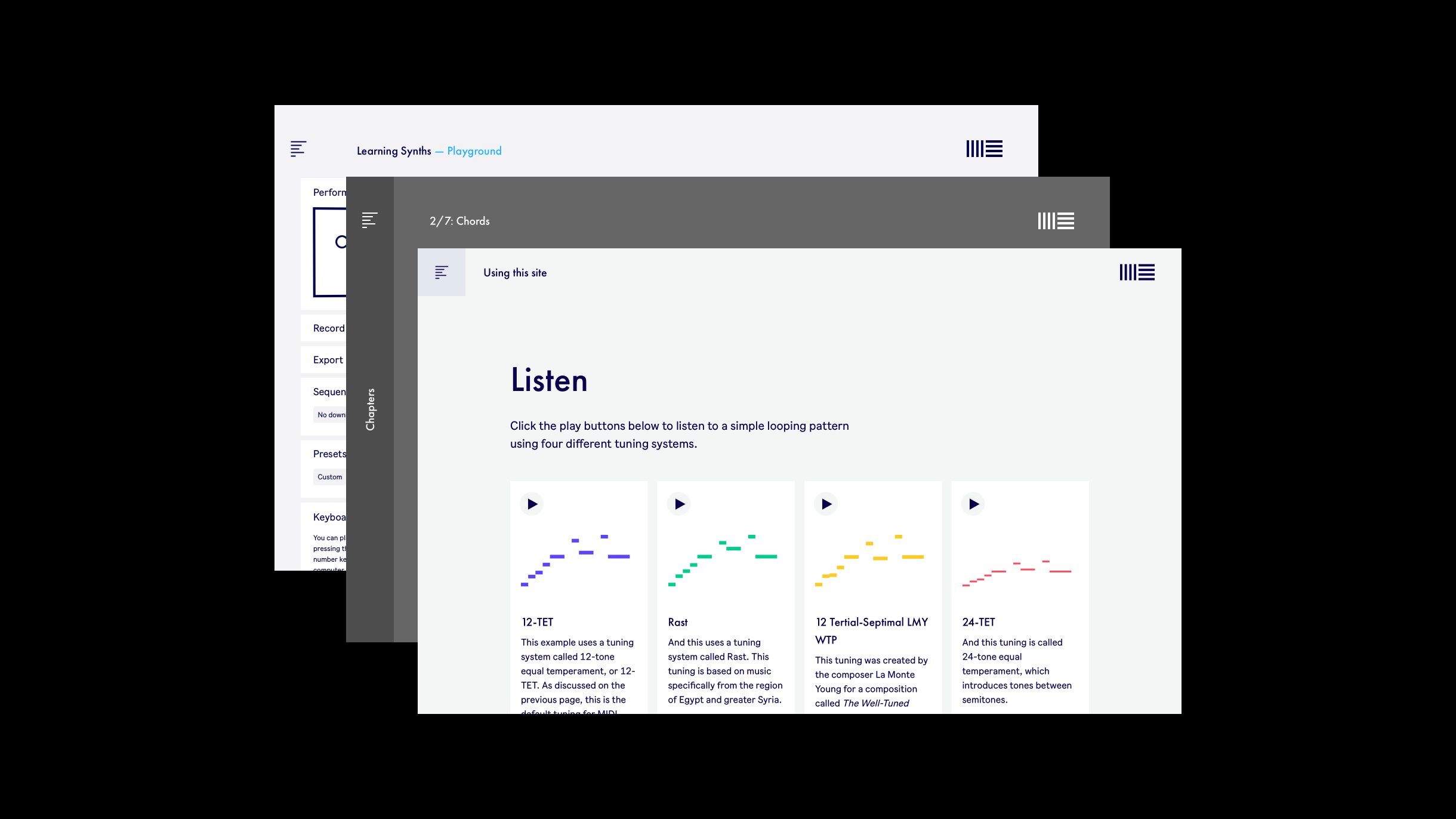
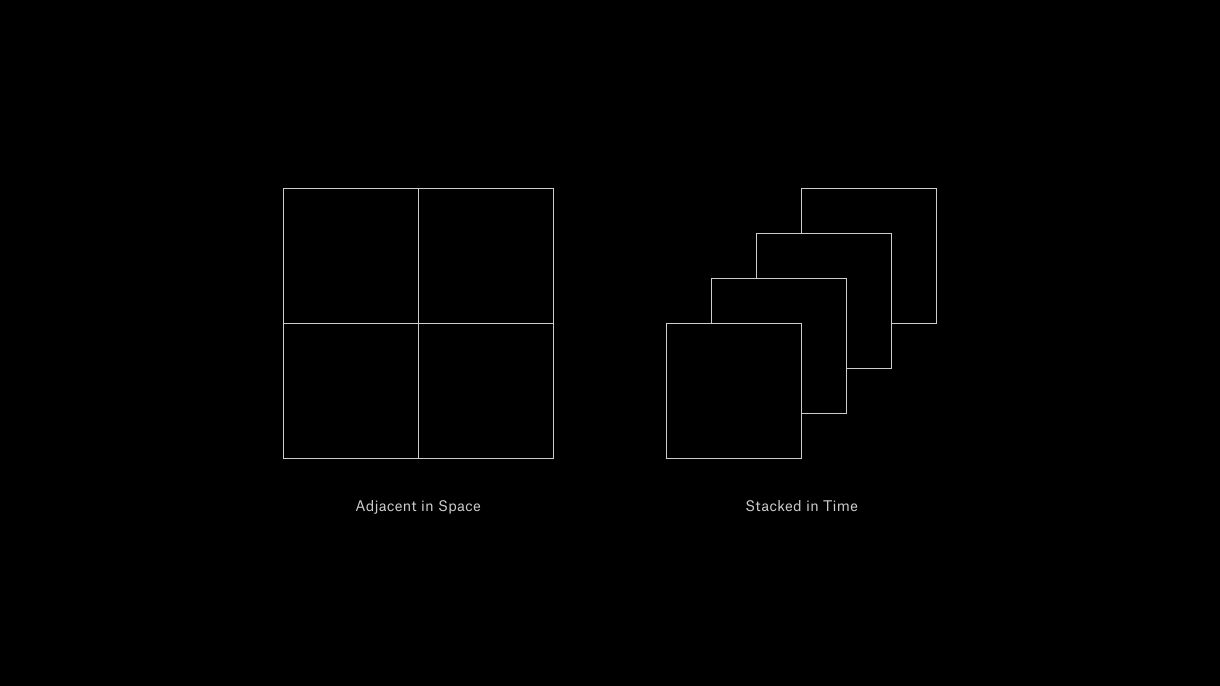
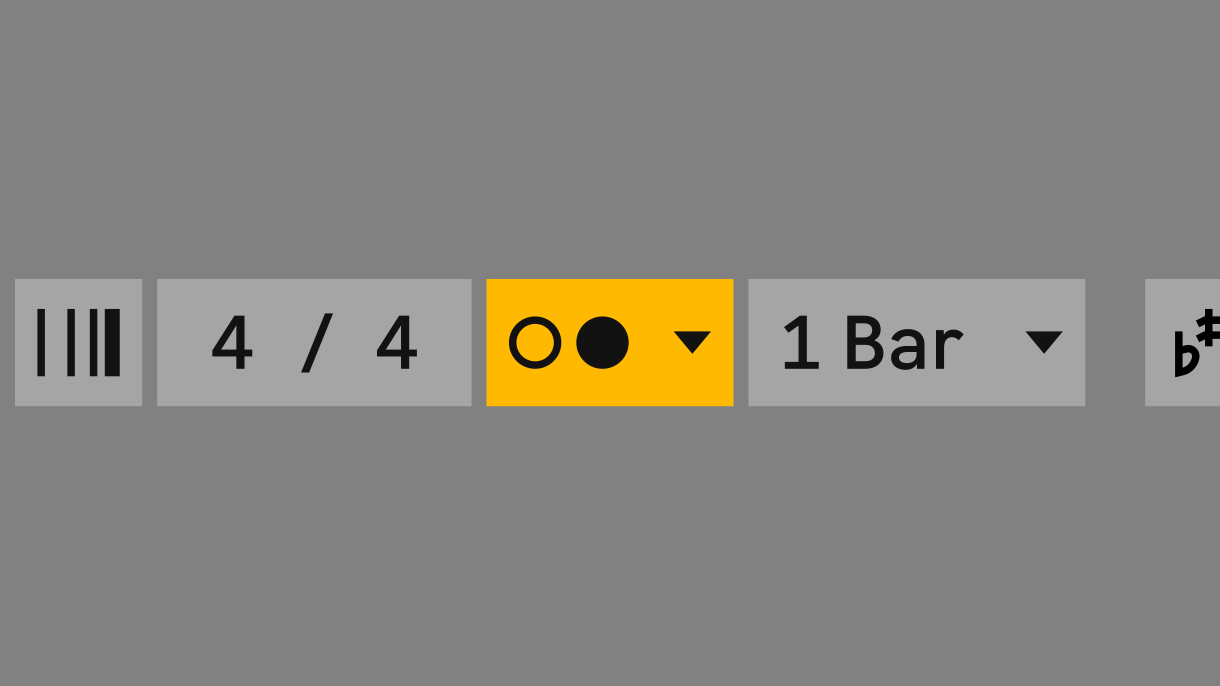
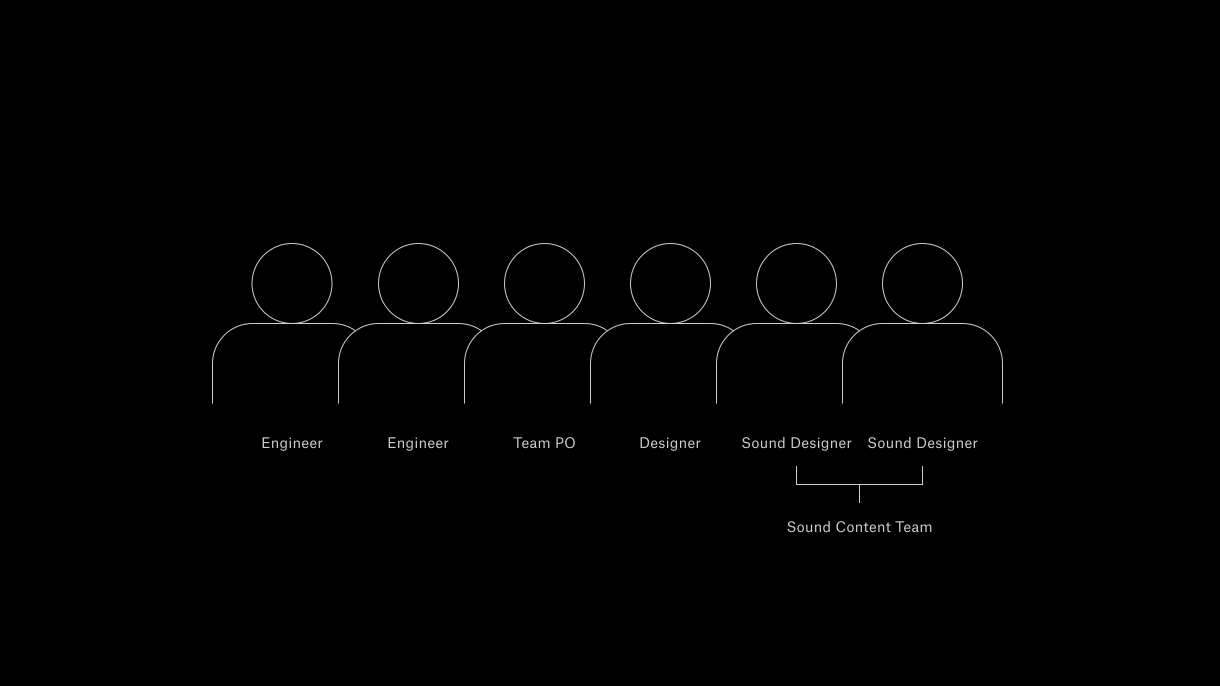
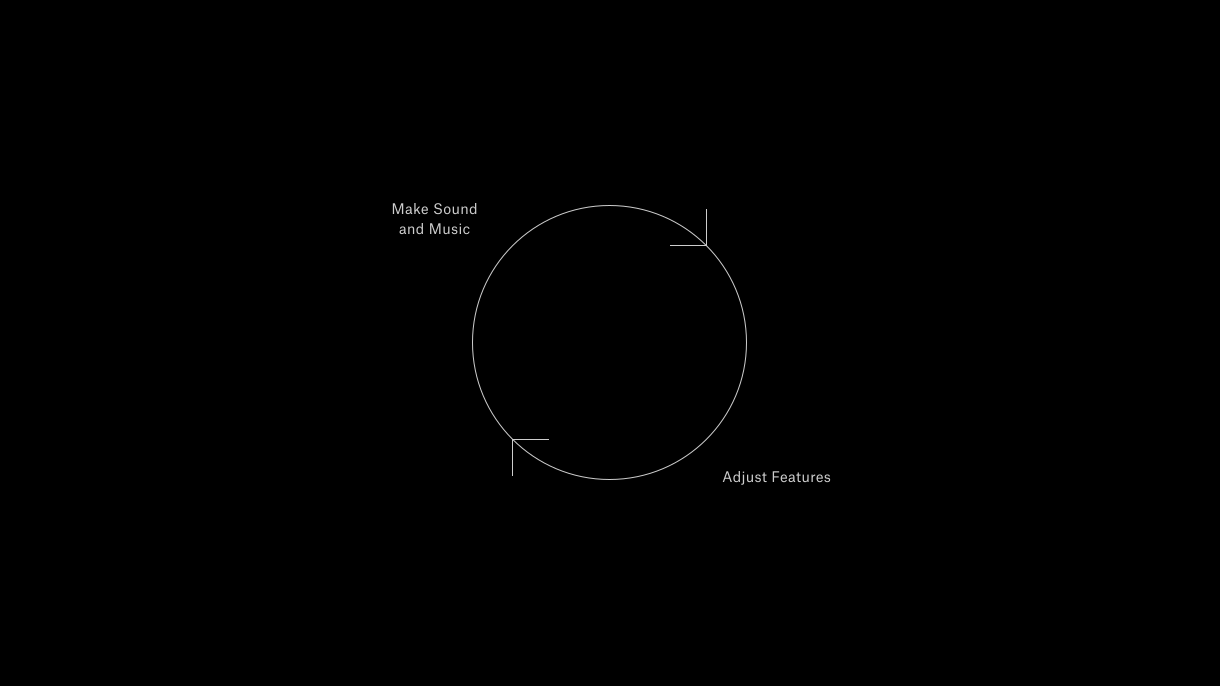
Hi, I’m Eric. Thanks to THU for the opportunity to speak. I’m a multidisciplinary designer — I’ve done graphic design, web design, illustration, and now digital product design. I work as a Principal Designer at Ableton, where we make creative tools for music makers.We make Live, which is desktop software for making music.We also make Push, which is a hardware controller for Live. Push also comes in a standalone version that runs Live on the hardware.Note is our mobile music making app for iOS. Two of the Note designers, Pablo Sanchez and Oliver Sommerman, gave a talk about its design at Config 2024.Move is our most recent hardware release, an ultra portable music making device.We also have various websites for learning different aspects of music making — Learning Music, Learning Synths, and Tuning.I've been at Ableton for 10 years, working as an interface designer focused primarily on Live's instruments, audio effects, and other features. By design I mean what things look like and how they work.Instruments and effects in Live are called “devices”. I’ve designed a lot of devices.Today I’d like to talk about the design of Ableton Live. I’ll share some of the foundational thinking behind its design, and also walk through an example project that illustrates some of that thinking. I’d like to do that through a lens of authenticity, because I think that’s something about Live’s design that has been very important to me. It will be a design-focused talk, but I don’t think you have to be a designer to appreciate it. That’s what you can expect for the next 45 minutes.What is Live? Live is desktop music making software for both studio use and live performance. It was originally made for live performance but evolved into a DAW (digital audio workstation). At 25 years old it has a lot of history. It’s been very influential, particularly on how electronic music is made.My story starts before joining Ableton. I was a big fan of Live. As a music maker it was really empowering. As a designer I came to develop a strong appreciation for its design. It was a bit unconventional, but it really expanded my understanding of what good design was.As it’s been around for so long it has changed in many ways, but in other ways it’s remained the same. I think part of that stability and continued relevance is due to some of the foundational thinking behind it.For this first part I’d like to go back in time and explore that foundational design thinking. I should note that this is not an official record. Some of the ideas have been shared before, while some are my own observations and things that I find valueable personally.It starts around the late 1990s with the founders, Gerhard Behles and Robert Henke, before the founding of Ableton.They were making music together under the name Monolake. While composing and performing they developed software to meet their own needs.The nature of their creative relationship is worth noting — in an interview Gerhard said: “I really like our dynamic of augmenting as your role, and reducing as my role. … One adds and the other subtracts.”Because they were music makers themselves they were able to start creating something with a deep understanding of the needs of electronic musicians. This subject matter expertise, coming from the people responsible for the software, is one of the first characteristics that I think are strongly reflected in Live.Early on there was more or less a clear vision of how they wanted it to be. One explicit characteristic was that it should be “like an instrument” — not software for making music, but software that turns your computer into something else, into an instrument.One example of this was the choice to style the dialogues like Live, rather than like the operating system. This one could use an update.It was also thought that ideally it should be used full-screen. But overall, like an instrument, it should be immediate and intuitive.From the beginning there was an appreciation for aesthetics — that it should be a beautiful, modern, and classic design object, in the Bauhaus or Modernist tradition. That was very much in contrast to other software at the time.With that came a desire for extreme simplicity — everything should be reduced to its most essential nature, zero decoration, zero distraction. Abstracted as much as possible. “A slider is just a line, a dial is just a curved slider.” A lot of music making software at that time looked like hardware. But the thinking was: this is software, it can look like anything. This was about 10-15 years before “flat design” was popularized.There was also a decision to keep all of the UI in one window. Someone said, “Window management has nothing to do with being a musician.”Instead everything is on the same level.It can be useful to think of interfaces in two ways — “adjacent in space” and “stacked in time”. “Adjacent in space” is ideal for large screens where you can display a lot of information at once. “Stacked in time” is more like what you find on smaller mobile screens, where less information can be displayed at once.There was also a decision to avoid requiring users to switch between different tools and modes, so there is only one tool. During my research I ran across the funny use of the word “toollessness”.Instead of tools users should be able to directly manipulate musical content with the default pointer. Direct manipulation is another principle that would later become commonplace with touch devices. So Live was looking ahead a bit.While there was a kind of “neutrality” in the design (though I don’t think “neutral” is a great descriptor, as I believe everything expresses something), there are also idiosyncratic or creatively inspired choices. One example is the metronome icon — someone saw a similar kind of blinking light during a visit to the airport and repurposed it. I think Live is an interesting balance between seemingly objective but also personal and subjective elements.Another personal characteristic is the role of technology in the design. Robert was trained as an engineer and has an appreciation for the beauty of well crafted technical systems. I think Live’s design is to some extent an expression of engineering.Speaking of aviation, airplane cockpits were also an early reference (and also “adjacent in space”). For live performance it was mission critical software. Whatever you needed should be right in front of you, where you expected it. A fixed UI that didn’t require much configuration.The “adjacent in space” interface is also notable because its undirected. How you can use it is very open, it doesn’t guide you in a particular direction. Like a sandbox its a space you can explore and experiment in. Sometimes when we’re designing a feature, we might consider how it could also afford uses we wouldn’t anticipate. It’s the “studio as an instrument” philosophy.From Just Enough Design by Taku Satoh: “The design of hashi is not design that instructs us, ‘Use me this way.’ Instead, hashi are essentially two sticks that somewhat indifferently suggest, ‘Use me however you want.’”This quality of openness also works in an aesthetic way. The lack of an explicit visual style leaves space for a personal emotional relationship. A heavily stylized design would dictate too much of that relationship. That doesn’t mean everyone will connect with it. I’ve heard people say “it looks like a spreadsheet”. But hopefully we offer enough customization to help with that.In Designing Design Kenya Hara talks about emptiness: “A vessel that’s empty has the possibility, precisely because it is empty, to hold things inside. In the same way, abundance lies in possibility — the possibility that exists before anything occurs.”That sounds like Live. For example, new sets are empty. There are no default presets loaded. That’s another kind of openness — Live doesn’t make a lot of decisions about what your music should sound like. Instead, for it to be your own artistic identity, its your responsibility to make those decisions.Lastly, I believe Live’s simplicity — reducing things to the essential, the direct manipulation of elements — these affect the feeling of working with sound. As a musician you have direct access to the “raw material” of music and composition.Like a modular synthesizer, it’s this low level thing that affords a kind of intimacy with the musical material.A lot of these characteristics point to a kind of honesty and authenticity — not design as an arbitrary style, or as a commodity, but an expression of something’s essential nature. There’s an authenticity of subject matter (the sound and technology) as well as an artists’s personal relationship with their tool. And I think that makes Live really special.So that was a lot on the high level, philosophical side. Now I want to zoom in a bit and look at how some of these ideas get applied in reality.The Live team itself is made up of about 60 people. We follow a typical agile software development process: feature teams of 4-6 people, cross-disciplinary. Typically a team lead, 2-3 engineers, and a designer.Because a lot of the people that work at Ableton are very passionate about music making, design input can come from most anywhere. That is very much in Ableton’s DNA.Let’s walk through a specific project and talk about Drift.Drift is a synthesizer released with Live 11.3 in 2023.The story of Drift starts with Marc. Marc is a software engineer and musician at Ableton.Marc really appreciated the sound of some hardware analog synthesizers (KORG Minilogue, Moog Grandmother). They had something missing from our own synths, so he wanted to explore it. He started a hack project to make a synth (hack time is time allotted at Ableton to work on projects outside of our usual ones). Soon Marc had a pretty clear vision for what he wanted. He had four principles:Less Complex, More Contained — Marc described two ways to design an instrument or effect. On one end of the spectrum, it’s like a big toolbox. Give the user a large set of tools they can do anything with. The possibility space is large but getting a good sound requires expertise.Alternatively you can make something with a much smaller set of tools. The possibility space is reduced, but it’s easier to use and requires less expertise. Complexity is hidden away, and the instrument designer can make their own choices about how those parts work, which affects the character. So this is actually one characteristic in contrast to what we said earlier about leaving things open and undirected.Less Mathematical, More Organic — Most Live synths are very clinical. Mark wanted a sound that was alive with character. Something with the personality of analog hardware. Imperfect and unpredictable, but musical.Performant — There was also a desire to make it lightweight on the CPU. He knew it might need to run on the upcoming Move hardware.Musicality — It should be designed to be as subjectively “musical” as possible. All of the complexity that’s hidden away should be carefully calibrated and balanced so that no matter how you use it, it will sound good.The timing was good, becase there was a need for a synth to run across our system of products, which would have similar requirements.So there was alignment and it became a real project. The team makeup is worth noting: two engineers (Marc) plus the team lead, UI designer (myself), and most importantly, two sound designers from our Sound Content team. The Sound Content team is responsible for the musical material that comes with Ableton products (samples, presets, etc.).Sound Designers aren’t usually involved in the design process, but here they were from the start. The team iterated through the early feature set by doing a lot of sound designing and music making.This was a very early prototype. There wasn’t an official name yet, but unofficially it was “Sub Zero”.This is a nearly feature complete version of the prototype after it had been through some rounds of iteration. This is when I started contributing as an interface designer.And this is one of the first versions of the “designed” interface I had done.Device design is like a puzzle — there are tight constraints on the Live design language, but we also want to give each one a unique identity.In this first version there was a particular choice I’d like to walk through. But first I need to explain how some parts of the synthesizer work.It has three oscillators. Oscillators are sound generators, and very fundamental to the instrument. You can see them here.Amongst other controls, each oscillator has these three: 1.) A button that turns the oscillator on or off. 2.) A volume control. 3.) A button that toggles the effect of the filter (the filter affects the sound).In my version I wanted to place the controls of each oscillator into explicit groups.So the previously mentioned controls moved here.Specifically I thought of these buttons that turn the oscillators on and off as very foundational. If they’re off everything that comes after is irrelevant, so I positioned them in the beginning of the oscillator group (if you are reading top down, left to right).I thought this was a UX improvement, to communicate each oscillator as a distinct group of controls. So we held a design review with the team, but unfortunately the design was not a hit. What was the problem? The problem was that it didn’t represent how the synthesizer actually works.There are really three distinct stages that the audio signal flows through (at least in the part we’re focused on here): 1.) The oscillators. 2.) A mixer for the oscillators. 3.) A filter.The left column of buttons toggle wether the signal flows into the mixer. The oscillators are always on, they don’t get turned off. The right column of buttons toggle wether the signal continues to flow into the filter. The mixer also affects the sound — it adds distortion depending on how things are set up.My design didn’t reflect any of that. I’d removed the mixer and misrepresented the signal flow. The UI didn’t communicate how the synthesizer actually works — it wasn’t an honest representation.This is the final design. The mixer was retained as a distinct element in the oscillator section. I’m grateful for the perspectives of the subject matter experts on the team, as their input helped to arrive at a design that better reflected how the instrument works.Color was also a question. Live was intended to have a primarily two color system. It starts to muddy the waters when we ask the system to do things it wasn’t intended for. I was against using a third color but the team preferred it.We considered using sliders to help communicate the hardware inspiration, but they didn’t make the cut as they aren’t space efficient. The oscilloscope is also worth noting as a small way to give some visual character, and as a nod to the Korg Minilogue influence.Drift was also an “adjacent in space” interface with most controls visible at once. I like Drift as an example because it reflects some of the foundational characteristics of Live — an inspired personal vision, contributions from a multidisciplinary team, reduction to the essential, and an authentic shape that reflects its nature. When I design something, I like to ask, “What does it want to be?” I want to give it an honest and authentic shape, and I think we were able to do that with Drift.Let’s zoom back out and look at Live in general.I mentioned that Live has been around a long time, and that it has in many ways stayed the same. But inevitably it also has to evolve to stay relevant. How do we stay oriented while it changes?We recently redefined our design principles for Live. There’s six of them. I’m paraphrasing — this isn’t an official record.Creative expression should be free-flowing and uninterrupted.Live can be complex, but we aim to solve design problems as simply as possible.Afford in-depth creative control grounded in reliability and trust.Meet the concrete needs of musicians while supporting open-ended paths.It should be visually appealing, a place you enjoy being in, while grounded in strong functionality and humility or restraint.We aim to offer stability for a long lasting creative practice, but also evolve to remain relevant to musicians’ changing needs.Let’s recap. We looked at how Live’s foundational characteristics reflect the authenticity of musical material and the relationship a musician has with their instrument. Then Drift, which exhibits some of those characteristics. And lastly the modern principles that keep us oriented as Live evolves.
I’d like to tie this back to Ableton’s mission — I think Ableton generally sees itself as a purpose-driven company. We believe music making is good for people. It’s hard but personally rewarding.
I think Live’s design is especially relevant while there is so much uncertainty in modern life. I’m fortunate to contribute to a tool of self expression that’s grounded in honesty and stability.
My takeaway is a belief that making something with a clear vision and a commitment to authenticity can help people develop a strong relationship with it. And depending on what that thing is, perhaps it can enhance their lives.